Brisket — the Science of Patience
Why low-and-slow turns the toughest cut on the cow into something legendary — and the four temperatures that actually matter.
Brisket is the cut nature designed to humiliate you. It’s the muscle a cow uses to hold its own bodyweight up — packed with connective tissue, ribboned with fat, and stubborn enough that if you treat it like a steak, it’ll punish you for it.
Treat it right, though, and it’s the best thing you’ll ever pull off a fire.
What’s actually happening in there
A brisket has two jobs to do while it cooks, and you can’t rush either:
- Collagen has to melt into gelatin. The connective tissue that makes the raw cut chewy starts breaking down somewhere north of 70°C and finishes in the 90–95°C range. Pull it early and it stays tough; push it further and the muscle fibers fall apart into a paste. The window is wider than people think — but it lives between two temperatures, not a clock.
- The fat has to render. That intramuscular fat is what makes a properly cooked slice glisten and stay juicy a day later. It needs time and gentle heat. Crank the temp to speed things up and you’ll render the fat out of the meat onto the coals instead of into it.
This is why brisket is a 1–1.5 hour-per-pound game. The clock is a guide; internal temperature is the rule.
The four temperatures that matter
- 107°C (225°F) — your pit. Boring, low, steady.
- 74°C (165°F) — the start of the stall. Moisture sweats out faster than the meat can warm up, and the thermometer parks itself for hours. This is where most people panic and crank the heat. Don’t.
- 88°C (190°F) — wrap territory. If you want to barrel through the stall, this is when you wrap in butcher paper (keeps the bark) or foil (faster, softer bark).
- 93–95°C (200–203°F) — done. Except “done” isn’t really the temperature — it’s whether a probe slides into the thickest part like it’s going through room-temperature butter. Trust the feel, not the digit.
The bark, briefly
The dark crust is the Maillard reaction plus the smoke ring (nitrogen dioxide from the smoke reacting with the meat’s myoglobin) plus rendered fat catching every spice you put on it. Your rub doesn’t need to be clever — coarse salt, cracked black pepper, smoked paprika, garlic powder, onion powder, equal-ish parts — but it needs to be on there generously and given hours of smoke to bake on.
If you want a sweet/spicy detour, brush a glaze of BBQ sauce, honey, and a spoon of harissa paste over the last hour of the cook. It’s not traditional Texas. I don’t care.
Rest. Then rest more.
Pull at 93°C, wrap in butcher paper, drop it in a warm (not cold) cooler for at least an hour, ideally two. The fibers reabsorb the juices that have been violently expelled toward the surface. Skip this step and you’ll slice into something that wets the board instead of your tongue.
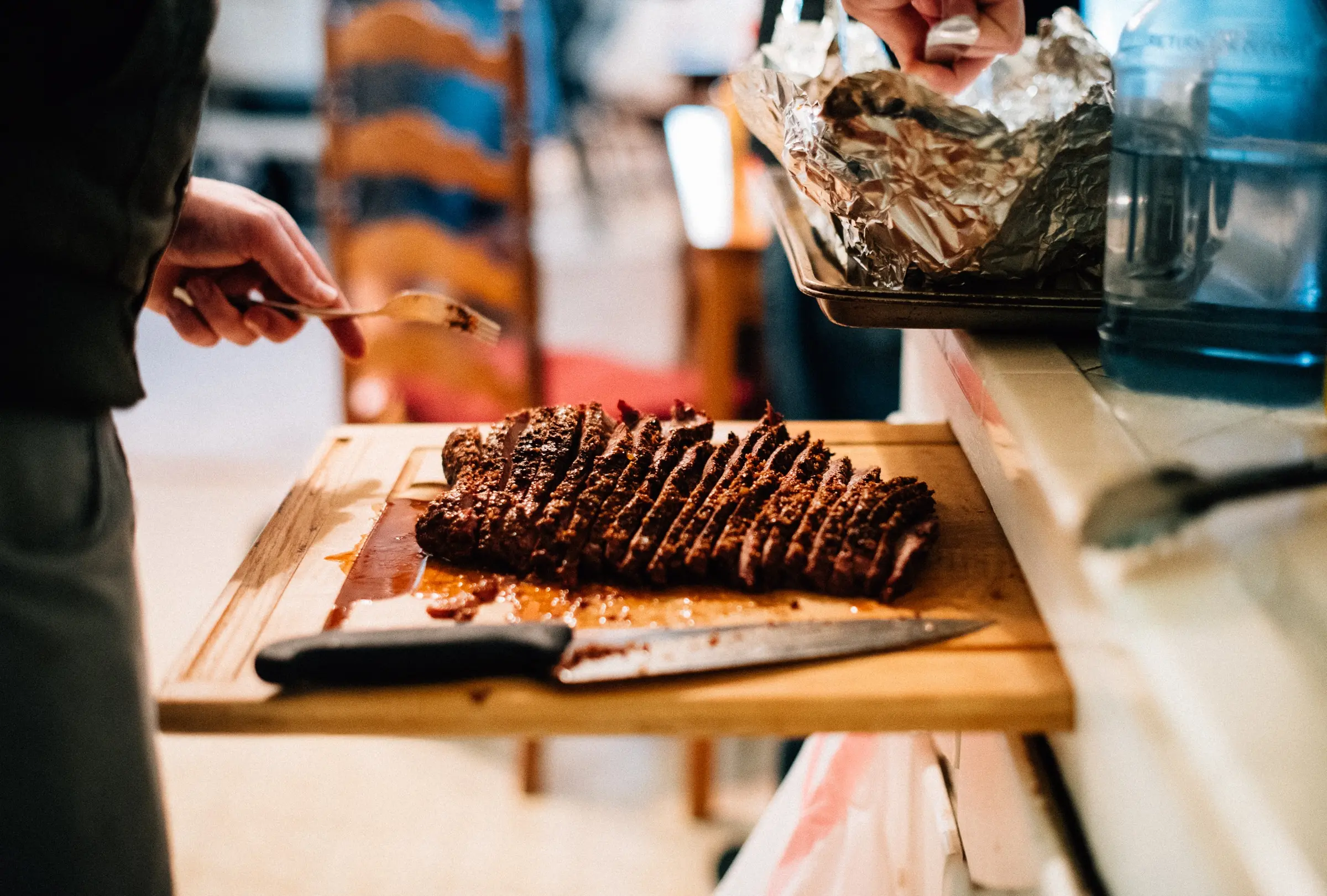
Slice across the grain
The grain in a brisket turns ninety degrees between the flat and the point. Find it, slice perpendicular, and each bite has short fibers your teeth can do something with. Slice with the grain and you’ll feel like you’re chewing rope.
Where this shows up
This is the technique behind every brisket dish I make. The slices go on a board with pickles and white bread. The trimmings and the burnt-end-y bits get diced and folded into my smoked beef chilli — a slice or two of brisket saved back, the rest into the pot with chipotle and dark beer. (Recipe coming. It’s worth the wait.)
Master the technique once, and the recipes basically write themselves.
What I learned the hard way
- A brisket cooked too fast looks done and tastes raw. Trust temperature, not time.
- A brisket cooked too low never builds bark — it stays soft like a pot roast. 225°F is the floor, not the ceiling.
- Buy the whole packer cut if you can find it. Flat-only briskets dry out and never give you the proper layered slice.
- If it’s your first one, do it on a weekend with nothing planned. Brisket asks for your attention. Give it.
Light a fire. Be patient. Slice across the grain. That’s the whole game.
Now go try it.