BBQ Chicken — Crispy Skin, Juicy Meat, Two Zones of Fire
Why most BBQ chicken is dry, rubbery-skinned regret — and the indirect-heat technique that fixes it.
Most BBQ chicken is bad. Dry breast, undercooked thigh, skin that has the texture of a wet plastic bag. It’s not the chicken’s fault — it’s that we tend to throw it straight over screaming-hot coals like it’s a hamburger, and then act surprised when it tastes like a hamburger.
Chicken is a two-temperature, two-zone bird. Cook it like one and the difference is night and day.
What’s actually happening in there
Chicken has two problems running on opposite clocks:
- The breast is done at 74°C (165°F). Push it further and it dries out fast — there’s not much fat in there to save you.
- The thigh isn’t safe to eat until 74°C, but it isn’t good until about 80°C (175°F). That’s where the connective tissue gives up and the dark meat goes from rubbery to silky.
So you’ve got a 6°C window between “breast is perfect” and “thigh starts being worth eating.” Direct-grill the whole bird and the breast hits 95°C before the thigh hits 80°C. Game over.
The fix is two zones: a hot side for sear and skin, a cool side for the slow finish. Cook the meat over indirect heat to the temperature it needs, then move it over the coals only for the final colour and crisp.
Why the skin disappoints (and what to do about it)
Crispy skin is mostly about dry surface + hot fat. Three things kill it:
- Moisture on the skin. Pat it dry. If you’ve got time, dry-brine the bird uncovered in the fridge for 12–24 hours — salt pulls moisture to the surface, where it evaporates. The skin goes paper-dry.
- Cooking the skin slowly. Skin needs heat. The two-zone setup lets you finish over direct fire at 200°C+ to crisp it without overcooking the meat.
- Trapping rendering fat. The subcutaneous fat under the skin has to render out and into the skin to crisp it. Score the skin lightly if it’s a fatty bird, or just let time do it.
A spoon of baking soda in your dry brine raises the surface pH and helps with browning — useful if you’re in a hurry.
The numbers that matter
- Pit/grill cool side: 130–150°C (270–300°F) — the indirect zone where the chicken does most of its cooking.
- Pit/grill hot side: 200–230°C+ (400–450°F+) — over the coals, where you finish for skin.
- 74°C (165°F) — pull the breast.
- 80°C (175°F) — pull the thigh.
- 15 minutes — minimum rest before carving, longer if it’s a whole bird.
For a whole chicken, that’s roughly 45–60 minutes indirect, then 5–10 minutes over direct fire to finish the skin.
Spatchcock if you want it even
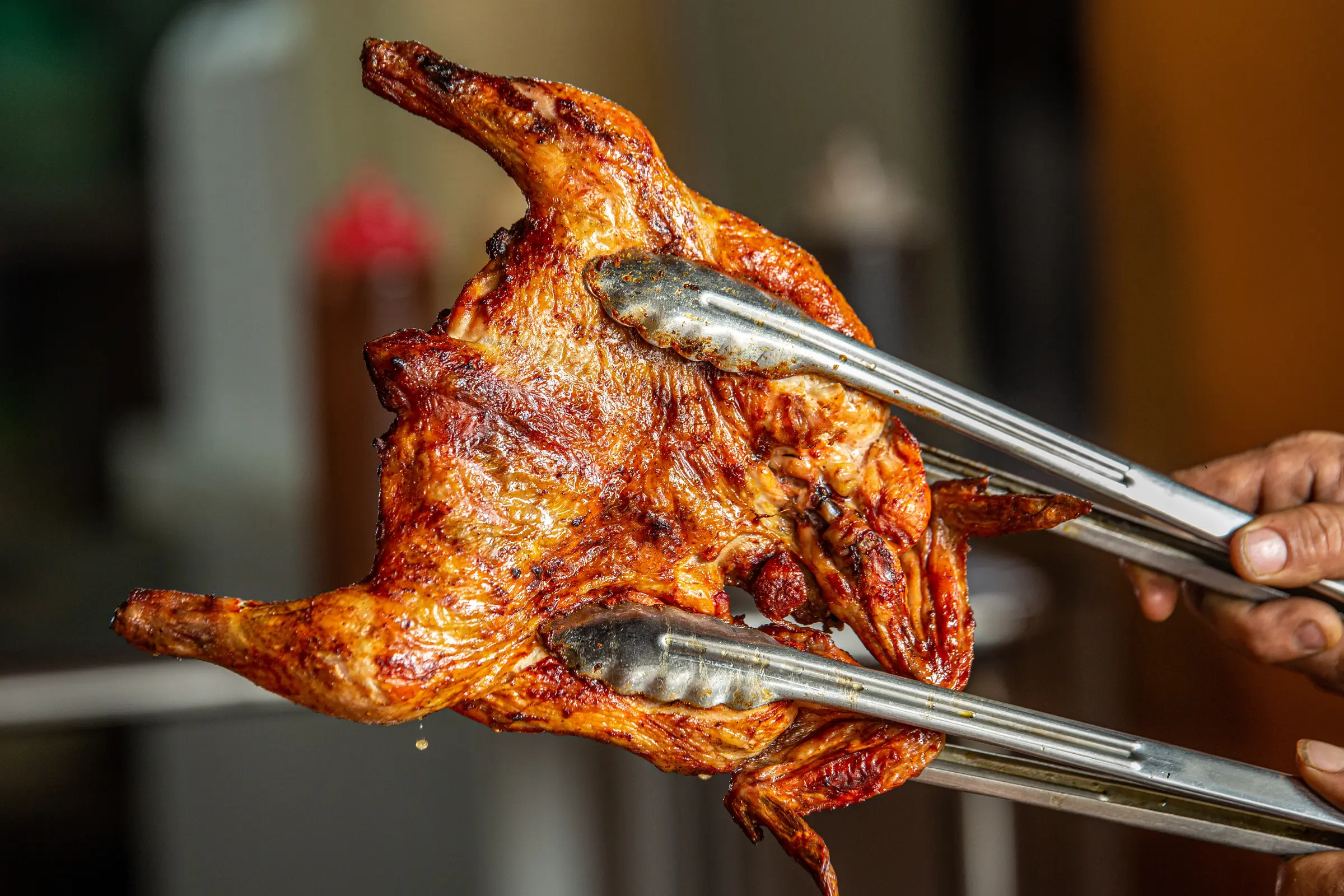
The single biggest improvement you can make to a whole bird is to spatchcock it — kitchen shears down either side of the backbone, flatten the bird, press the breastbone. It does three things:
- Cooks faster (more surface exposed).
- Cooks more evenly (no thick centre cavity hiding under-done thigh).
- Lays flat on the grill so the skin gets uniform contact with the heat.
If I’m cooking a whole bird outside, it’s spatchcocked. Always.
Where this shows up
This is the foundation under every chicken recipe on the site. The cleanest example is the Harissa Chicken — thighs threaded onto skewers, cooked indirect first to get them through, then dragged over the coals for char. Same two-zone logic. Same temperature targets.
The same technique works for peri-peri, buttermilk-brined chicken, or anything where you want skin you can actually hear when you bite into it. Master the two-zone setup once and the recipes are mostly about the marinade.
What I learned the hard way
- Direct heat is the finisher, not the cooker. If your chicken is over flames the whole time, you’re going to chase the breast and lose the thigh.
- Skin won’t crisp under a sauce. Sauce in the last five minutes only. Earlier than that and it turns to glue.
- Brine the bird, even just dry-salt overnight. It’s the difference between hotel-buffet chicken and the chicken people remember.
- A meat thermometer pays for itself in one bird. Stop guessing.
Light the coals on one side. Salt the bird the night before. Cook indirect until the breast is at 74°C. Sear, rest, carve. That’s it.
Now go try it.